

|
|
 |

home > March 24, 2008 issue > article

Shifting frequencies
 By Sean Gallagher and Larry Loeb
 The changes made in the JTRS radio program have changed the game of development and procurement of communications gear — and might have provided a new model for joint systems development
 After more than 10 years of research and development and a bevy
of critical reports from the Government Accountability Office the
Defense Department is now finally coming close to delivering a new
generation of radio systems to the military services.

In March, the Joint Tactical Radio System (JTRS) will clear another hurdle with
the award of its contract for the system development and demonstration phase of
the Airborne and Maritime Fixed Station Joint Tactical Radio System. AMR JTRS
will provide the networking backbone for ships and early warning aircraft.
The success of the program was far from certain just a few years ago.

According to executives at the Joint Program Executive Office (JPEO)
for JTRS and reports from GAO, JTRS was at risk of substantial further
delays and cost overruns. In 2005, JTRS Cluster 1 program, now
renamed the Ground Mobile Radio, was running behind schedule,
and DOD had sent a show-cause letter to Boeing, Cluster 1s prime
contractor, stating that it might terminate the contract because of anticipated failure to meet cost, schedule and performance requirements.

But a major overhaul of the program and a new approach to contracting
for JTRS acquisitions have already yielded substantial benefits,
JTRS program officers say. The program is now a test bed for
how to run joint procurement programs.

Were not saying this is the right model for DOD in all functional
areas, said Dennis Bauman, the programs JPEO. Were not out to
preach. But he said that the model JTRS has created will significantly
reduce the cost of future procurement because the new approach
has built both competition and an open-source approach to technology
development into the program.

THE TACTICAL EDGE
JTRS is a key element in DODs shift to network-centric operations.
Launched as a set of procurement programs in 1997, its goal was to
extend the edges of the Global Information Grid (GIG) through the
use of software-defined radio (SDR) technology.

From the start, JTRS was supposed to improve the interoperability
and lower the cost of communications systems by creating a family
of radios based on a single software architecture: Software
Communications Architecture (SCA) is the operating system on
which all JTRS elements are being built.

By using a variety of waveforms standardized sets of radio transmission
types paired with software interfaces for specific applications
that run on top of SCA JTRS radios can potentially deliver data,
voice and video to warfighters in the field and ensure that all the communications
of forces in the field are interoperable. And by adding
new waveforms on top of SCA, JTRS radios could be configured to
take on new tasks.

DOD is on a path to achieving a network-centric warfare capability,
Bauman said. We have a GIG. But without JTRS, net-centric
stops at the command center. We have to do mobile ad-hoc networking
out to the tactical edge.

But after more than eight years of development, JTRS looked more
likely to deliver a defense procurement cautionary tale than the badly
needed last mile of the GIG. JTRS has faced organizational and technical
problems that contributed to program delays and increased cost
and increased scrutiny from GAO and Congress. GAO estimated
total JTRS spending as of fiscal 2007 at $37 billion.

After reorganizing the program into a single JPEO, JTRS has
apparently turned things around. In January, Bauman and Howard
Pace, JTRS deputy JPEO, said that the new enterprise model had
already resulted in $104 million in program savings. In the process,
JTRS has become more than just a radio acquisition program it has
become an effort to fundamentally change how the services buy communications
hardware.

ON THE ROCKS
Back three years ago, JTRS was on the rocks, Bauman said. In
August 2003, GAO told Congress that despite its technical
advances, JTRS still faced significant technical and management
risks. GAO listed a number of concerns, but the most significant
challenge we identified is the lack of a strong, joint-management
structure, the report states.

Part of the problem was that each of JTRS components was its
own Acquisition Category 1D program, led by a specific stakeholder.
There were five [acquisition] programs run by the services,
and they werent federated at all, Bauman said. Because the
services each controlled their own programs, joint requirements
were suffering.

As a consequence, the GAO report states, several program
development efforts, such as handheld radios, have been delayed
by more than a year. In the meantime, the Army has purchased
more existing radios with fewer communications capabilities,
which may further delay the delivery of JTRS capabilities to
users.

Another problem was the huge number of features included in
JTRS initial specifications. The mass of requirements defied quick
delivery. And when the program was getting under way, SDR technology
which, along with SCA, is at the heart of JTRS was still
relatively immature.

In the first request for proposals, the government tried to get all of
their features in, so it ended up pretty feature-rich, said Dominick
Paniscotti, vice president of engineering for SDR products at
PrismTech, an SDR middleware vendor and a member of the initial
SCA working group.

A lot of folks were trying to get their requirements into it,
Paniscotti said. People were trying to make sure that their needs
were satisfied. Industry had to respond to that, or they werent going
to win the proposal.

Bauman agreed. We found that each of the five programs was
[aimed at] delivering everything at once. That was a recipe for
disaster.

UNDER NEW MANAGEMENT
In 2005, JPEO began a reorganization of the five programs.
The Undersecretary of Defense for Acquisition, Technology
and Logistics Michael Wynne now secretary of the Air Force
formed the centralized Joint Program Executive Office ( JPEO)
for all five JTRS acquisition programs, putting them under a single
executive officer Bauman and creating a board of directors
with representation from each service. The board puts
everyone in the room you need to make and approve a decision,
Bauman said.

The JPEO also broke the projects down into increments, Bauman
said. Weve defined Increment 1, he said, and were now working
with the Joint Staff to define the functionality for Increment 2.
The original 32 waveforms required for JTRS were cut to nine for
the first increment of the program. A fully compliant JTRS radio
might have to execute several different waveforms simultaneously, so
limiting the number of possible waveforms reduces the complexity of
the initial radios.

Paniscotti said redefining the core technologies for Increment 1 has
been a definite plus for JTRS. What you have seen over the last few
years is a tailoring back of the functionality that is in the radio, rather
than a tailoring back of the underlying architectural pieces of the
radio.

The JPEO also re-examined the whole model of development and
procurement of the radio systems.

The programs had a traditional approach to acquisition with
open competition for development and sole source for production,
Bauman said. The end product of that is that we end up in a sole-source
situation where all the capital is owned by a single vendor.

The new business model extends competition beyond the bidding.
We still do open competition for the design phase, Bauman said.
But we require that we qualify at least two sources and then compete
annually on lots for production.

Bauman said the Multifunction Information Distribution System
(MIDS) Low-Volume Terminal is an example of the success of this
approach. There are three qualified vendors for MIDS DLS, ViaSat
and EuroMIDS and a multiyear contract has been awarded to DLS
and ViaSat for fulfillment.

However, instead of simply setting a price for the systems in
the contract, DOD consolidates requirements for new terminals
each year and has the vendors compete on each lot of
requirements.

The original authorizations were
$6,000 each for the terminals, and the
initial production units were in the
$4,000 range, Bauman said. Weve
now driven the price down to $180 per
terminal.

JPEO JTRS is applying the approach
used with MIDS across its programs.
Were not requiring the customer [services]
to compete on our contracts,
Bauman said. The Army can sole-source
if they want were not responsible for the procurement dollars. But
we have a single [communications] purchasing organization for the
DOD for the first time.

Another way JTRS is breaking the single-source model is by keeping
ownership of the software used in the radios.
All JTRS software uses SCAs 26 application program interfaces
based on the Common Object Request Broker Architecture. This
makes it possible to port the software between hardware platforms if
DOD changes suppliers, Bauman said.

All software for JTRS more than 4 million lines of code, according
to the JTRS program office is placed in a repository. All of the
companies developing for the JTRS program have access to the repository
and are checking code in.

We give a library card to the code to vendors who demonstrate
theyre using it for government services, Bauman said. But in a fashion
similar to open-source software licensing, if they change it, they
have to put the changes back in the repository.

The result is that the barrier to entry for potential new suppliers for
JTRS radios is significantly lower. It makes competition that much
fiercer. Bauman said the JPEO has a rolling admission capability for
vendors as a result. It helps us sustain a wider vendor base. You dont
have to win [a system development and demonstration] contract to
compete.

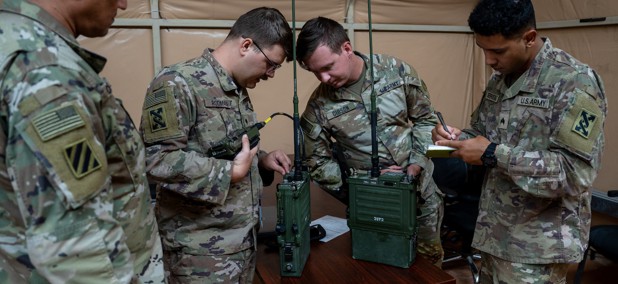
The model has worked with the first set of JTRS-compliant radios
to be approved. Two radios have been certified as SCA-compliant by
JPEO Thales Communications JEM and Harris Falcon III.
Thales had developed JEM for the Consolidated, Interim, Single-
Channel Handheld Radios (CISCHR) contract, originally under the
auspices of the Special Operations Command, Bauman said.

When CISCHR was rolled into JTRS, Thales modified the
radio to make it JTRS-approved running on SCA, with a single
waveform, with embedded cryptography and certified by the
National Security Agency as secure. Normally, we would have
had sole-sourced to Thales, Bauman
said. Instead, Harris got its commercial
Falcon III radio JTRS-approved on
their own dime.

Harris and Thales have come on
faster than expected, especially when
you consider that they werent on the
ground floor of this, said Brad Curran,
senior industry analyst at Frost and
Sullivan. But they stepped up to the
challenge. They saw there was a gap
here, so they made improvements to the
existing radios and developed new ones.

As a result, JPEO issued a $128 million indefinite-delivery, indefinite-
quantity contract for 39,000 radios, and the two companies
have bid on lots. The Marine Corps picked up the Falcon III on its
own contract. We were able to return $104 million to the Army,
Bauman said.

OFF THE SHELF
Although not having a single source might pose some challenges for
logistic issues such as repairs, the dramatically lower cost of the systems
reduces that issue, both Bauman and Pace said.

When you compete in production, you save money on purchase,
but in most cases, you need to sustain two devices, which
will admittedly cost more money, Bauman said. But some of the
radios cost less than $3,000 in some cases, its not even economical
to fix them.

But Bauman said the program is delivering now and wont get
pushed aside by the need to refresh older hardware now. JTRS is
crucial to DOD. It didnt get marked down a single dollar [in the fiscal
2008 budget]. Were delivering capability today. And, he said,
he believes the new model for JTRS will continue to deliver.


|
 |
|
|